Showing posts with label Buddhist Monk Stores. Show all posts

07 November, 2013

The Abusive Brothers - Buddhist Monk Stores,

The Abusive Brothers 


                                             ONCE THERE WAS A BRAHMIN whose wife loved to praise and speak kindly of the Buddha. He did not mind it at first, but soon his wife’s increased fondness for the Buddha caused him to become jealous.

                                 One day he went to where the Buddha was staying, armed with a question he thought would leave the Buddha baffled and humiliated. In that way, he thought his wife would realize how misplaced her admiration for the Buddha was.

                                 The husband asked the Buddha, “What do we have to kill to be able to live happily and peacefully?” The Buddha’s reply was simple but one that left the angry man appeased and inspired. “To be able to live happily and peacefully,” the Buddha replied, “one has to kill anger, for anger itself kills happiness and peace.” The man reflected on the Buddha’s answer and decided to become a bhikkhu himself. Finally he became an arahat.

                                When the younger brother heard that his elder brother had become a monk, he in turn became very angry, He went and confronted the Buddha, abusing him badly. When he had finished his string of abusive words, the Buddha asked him, if you offered some food to a guest who came to your house, and the guest left without eating any of it, who would the food belong to?” The brahmin conceded that the food would belong to him. The Buddha then said, in the same way, I do not wish to accept your abuse, so the abuse belongs to you.” The man realized his mistake and felt great respect for the Buddha because of the lesson he had taught him. He, too, became a bhikkhu and later also attained araharship.

                               The bhikkhus remarked how wonderful it was that the Buddha could make those who came to abuse him realize the Dhamma and take refuge in him. The Buddha replied, “Because I do not answer wrong with wrong, many have come to take refuge in me.” 

Almsfood is Almsfood - Buddhist Monk Stores,


Almsfood is Almsfood 

                            ONCE THERE LIVED a kind-hearted Brahmin who often offered food to the Buddha and his monks whenever they came by on their almsround. One day they happened to arrive when he was already in the middle of his meal, and though they patiently stood in front of his door, he did not notice them. His wife did, however, but she did not want her husband to know that they had come, for she knew that he would surely offer them the rest of his meal. That would mean she would have to go back into he kitchen and cook some more, which she really was not in the mood to do.
                      So she stood in front of the doorway in such a way that the Buddha and his monks remained cut from her husband’s view. She then quietly eased herself to the door within the Buddha’s listening reach and whispered to him through he corner of her mouth that there was no almsfood for them that day.
                      The Buddha and his disciples were already walking away when the husband noticed his wife’s strange behavior and asked her what she was up to. As she turned from the door, he caught sight of the edge of a monk’s robe leaving the doorway and immediately realized what had happened.
                      He jumped from behind his unfinished plate of food and ran after the Buddha. He apologized profusely for his wife’s crude behavior toward them and begged the Buddha to return with him and accept his food, although already partially eaten. The Buddha did not hesitate to accept the hrahmin’s offer and said, “Any food is suitable for me, even if it be the last remaining spoonful of an unfinished meal, for that is the way of a bhikkhu. The brahmin then asked the Buddha how a bhikkhu was to be defined. The Buddha’s response was quite succinct and ckar “A bhikkhu,” he said, “is one who no longer has any attachment to body or mind and does not long for what he doesn’t have.” 

Sainthood on Top of a Pole - Buddhist Monk Stores,


Sainthood on Top of a Pole 

                             ONCE A WANDERING TROUPE of circus performers were in vited to the palace to perform for the king and his court. Among the troupe’s jugglers and acrobats was a charming young lady who danced with grace and agility on the top of a long pole. One of the young men in the audience, named Uggasena, fell in love with her and even tally married her. Finally when it was time for the troupe to move on to another town, he and his new wife decided to move on with them.
                       Uggasena, himself, though, did not have any special talent that the troupe could use, and so was relegated to moving and packing crates, driving cans, and other menial tasks. This displeased his wife.
After some time, they had a son. One day, Uggasena could not help but overhear the lullaby his wife was singing to their child: “You poor child, your father can only carry boxes and drive carts. Your father is truly worthless.”
                       Thinking that his wife’s arrogance was due to her skill as an acrobat1 he decided to become one himself. He asked his father-in-law to train him, and not long after, he was ready to perform. On the day of his performance, he climbed up his pole with facility, and once on top. did somersaults that left the audience gasping in horror but utterly delighted.
                      While he was performing, the Buddha happened to pass by and saw that Ugassena was ripe for arahatship. So be drew the audience’s attention away from Ugassena by his will power and left him stranded on top of his pole with no applause. “My wife will laugh in my face,” Uggascna thought, “if she finds out that the audience lost interest in my act even before I was half way through it?” Feeling distraught, he just sat on his pole and sulked.
                       The Buddha then called up to him and said, “A wise man should work diligently toward abandoning all forms of attachment and thus be free from having to be born again.”
Uggasena reflected on the Buddha’s words and attained arahaiship while still sitting on top of his pole. 

The Ungrateful Sons - Buddhist Monk Stores,

The Ungrateful Sons
 
                         ONCE THERE WAS AN OLD MAN who was very well off, and when his four sons got married, he gave each of them a generous portion of his wealth as a wedding present.
                         Then his wife died, and although his sons affectionately looked after him after that, they did so with a devious ulterior motive: they wanted to possess the rest of his fortune. And they finally succeeded, leaving their aging father with hardly a cent left to his name.
                          Unable to manage by himself, the father went to stay at his eldest son’s home. Not more than a few days later, however, he was driven out by his nagging daughter-in--law who did not want to have anything to do with an unwelcome “burden” in her household. To add insult to injury, his ungrateful son raised no objection to his wife’s doing. The poor old man was to receive the same mean hospitality at the house of each of his other three sons.
                           Helpless and miserable, the father went to seek solace and advice from the Buddha, with nothing but a staff and a bowl that he could call his own. After the old man recounted how his sons had mistreated him, the Buddha told him how to go about teaching his greedy and ungrateful sons a lesson. The Buddha instructed him to say the following words whenever he found himself in a crowd of people: “My greedy sons are deceitful and unkind. They call me father but do not understand the meaning of the word. Now that I have given them all of my wealth, they have let their wives drive me out of their houses and treat me like a beggar. Alas, I can depend more on this old and crooked staff of mine than I can on my own four sons!”
                           As advised by the Buddha, the old man went about announcing the cause of his wretched condition whenever he came across an assembly of people. Then one day he came upon a crowd in which his ungrateful sons were also present. When he had finished his plaintive announcement, the people listening to him were filled with pity. Their pity. however, turned into rage once they realized that the very sons the old man was complaining about were among them. The Sons had to flee for their lives.
                           When they were sure they were out of danger. the sons sat down and discussed their poor father’s situation. They ashamed admitted that they indeed had been ungrateful and disloyal to a father who had always been but good and generous to them. Filled with remorse, they went to look for their father, and finding him, asked for his forgiveness. They also promised that they would look after him and respect and honor him as a father should he. They also warned their wives to take good care of their father or else they would be in great trouble indeed.
                             One day. the eldest son invited the Buddha to his house for a meal at which time the Buddha gave a sermon on the merits that one gains by tending to the welfare of one’s parents. He included in his sermon the story of Dhanapala, an elephant who cared so much for his parents that when he got caught. was unable to ear because he was so worried about them. 

The Great Pretenders - Buddhist Monk Stores,

The Great Pretenders 

                                           ONCE THERE WAS A TIME of great hardship in the country and the monks who were spending the vassa near a poor village found themselves with very little lay support.
                                 In order to get enough food, the bhikkhus addressed each other in such a way that the people in the village, never suspecting that they would be deceived by monks, believed that they had attained sainthood. And as the news of them spread, they gained even more respect. So the villagers, although themselves struggling to survive, mangaged to pool together enough food to keep their “saints” well fed and comfortable.
                                When the vassa came to a close and all the bhikkhus who had spent their vassa away from the Buddha went back to pay their respects to him, as was the custom, the well-fed bhikkhus stood out like a sore thumb. Everyone else looked so thin and pale next to them.
                                The Buddha asked the healthy bhikkhus how they had managed to do so well when the other monks could barely get by. The bhikkhus, expecting praise for their cleverness, recounted how they had misled the poor villagers into believing that they were saints. “And are you really saints?” the Buddha asked them, knowing full well that they were not. When they admitted that they were not, the Buddha warned them that to accept requisites from lay supporters, if they did not truly merit them, was indeed very unwholesome action and should he refrained from

The Diligent Do Not Sleep - Buddhist Monk Stores,


The Diligent Do Not Sleep 

                                     PUNNA WAS A SLAVE GIRL who often worked until very late at night. One day it was already nearly midnight when she had just finished pounding some rice for the next day’s meal. Tired, she stopped to rest for a while, and as she did, she noticed Some monks who were on their way back to their monastery after listening to the Dhamma in a nearby forest. She could not help but wonder what they could be doing up so late. i myself have to be up late because I am poor and have to work hard,” she thought to herself, but what could monks be doing up at this rime of the night?” She guessed that maybe one of them had had an accident or was sick, or something of that nature.
                            The next morning. Punna was about to eat a pancake that she had made from some leftover rice Hour when she noticed the Buddha passing by her master’s house. She had always warned to make an offering to the Buddha but rarely had a chance. It seemed that when she did have something nice to offer him, the Buddha never came around, and when she did not have anything, she would see him. Although what she had was just a coarse pancake, she still wanted to offer it to the Buddha, and although she was truly afraid that he would not accept such unrefined food, she went ahead and offered it to him anyway. lb Punna’s surprise and joy, the Buddha not only humbly accepted her pancake, but sac down in a suitable spot and ate it right in front of her.
                             After the Buddha had eaten the pancake, Punna. still curious about he monks she had seen the night before, asked the Buddha what they could have been doing up at such a late hour. The Buddha replied by saying, “Punna, just as you have no time to sleep because you have to work hard pounding rice late into the night, my disciples do not go to sleep because they have to work hard at being vigilant and mindful.” The Buddha then went on to tell her that it did not matter what position one had in life, be it king, slave, or monk. What really mattered was that one never ceased w he mindful and vigilant.
Punna reflected on the Buddha’s words and realized the Dhamma. 

The Power of loving Kindness - Buddhist Monk Stores,


The Power of loving Kindness 

                                  NEWLY-WED UTTARA was not very happy in her new household, for although she loved to prepare almsfood for the Buddha and his disciples, she was too busy looking after the needs of her new husband to do so. She complained to her father about it and he, feeling sorry for her, sent her some money. Uttara then asked her husband if she could use it to hire a maidservant who would look after him while she used her own time to prepare almsfood for the Buddha and his monks. The husband agreed and a maidservant was employed.
                        One day, while Uttara was busily preparing food for one of her merit-making ceremonies, her husband happened to pass by the kitchen. Seeing his wife so happily engaged. he thought to himself. “What a foolish little woman! She should be enjoying herself instead of working so hard. And he smiled at her affectionately.
                        When the maidservant saw his smile, she forgot that she was only a hired hand, and in a fit of jealousy, took a pot of hot boiling butter from the stove to pour over Uttara. When Uttara realized what the maid was going to do, she made this resolution: “Let the butter scald me only if I bear any ill-will toward my maidservant.” But ill-will was far from the heart of Utrara. Instead, she felt only loving kindness and gratitude coward her maid, for Uttara realized that without her, she would not have been able to carry out all of her merit-making activities. Consequently, the hot butter simply rolled off Uttara’s body like drops of cold water.
                       When Utcara’s attendants realized what the maid had done, they seized her and started hitting her from all sides. Uttara immediately ordered them to stop.The maid then realized that she was in no position to be jealous of Uttara. Feeling ashamed, she asked Uttara for forgiveness.
                        Later when the Buddha learned what had happened, he praised Uttara for having conquered anger by loving kindness. He further instructed his listeners that abuse should be conquered by non-abuse, selfishness by generosity, and lying by speaking the truth. 

The Cloth Baby - Buddhist Monk Stores,


The Cloth Baby 

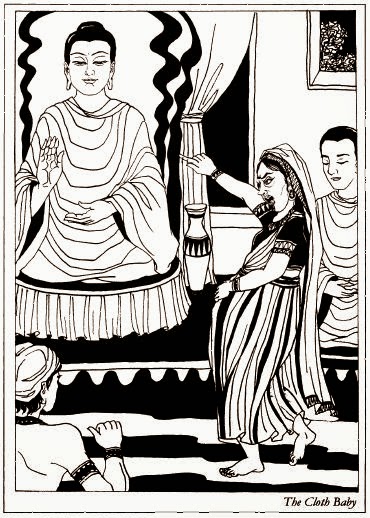
                          AS MORE AND MORE PEOPLE became attracted to the Buddha and his teachings, the ascetics of other religions became very jealous and schemed to ruin his reputation. They asked a not uncomely young female follower of theirs to help them carry out their plan.
                         One day, as evening fell, the young woman started to walk in the direction of the monastery where the Buddha was staying, but in fact went and stayed at the jealous ascetics’ place for the night. Early the next morning as she returned home, her curious neighbors asked her where she had been. She misled them to think that she had spent the night with the Buddha.
                        After a few months had passed, she began to wrap some cloth around her stomach to look pregnant, and as the months went be she kept adding more cloth until she really looked like she was about ready to give birth. She also beat up her hands and feet until they became swollen and pretended to be feeling tired as real pregnant women do. Looking like that she went to accuse the Buddha.
                       The Buddha was in the middle of giving a discourse when she arrived, holding her stomach to accentuate her condition. Seeing him preaching, she confronted him and said, “Instead of shooting your mouth off like that, you should be taking care of me and your baby! Now that you have had your fun, you are no longer interested!” The Buddha let her finish speaking and then said calmly. “Only you and I know if your words arc true or not.” “You’re right!” she scoffed.
                      “No one else could see what we were doing in the...” Before she could finish her sentence, the strings holding the bundle of doth around her stomach loosened and the “baby” fell down to her feet. Those in the congregation then realized that the woman had been lying. They scolded her severely and called her a wicked woman, a liar, and a cheat. Afraid that they would do her harm, she ran away as fist as her legs could carry her. She did not get very far, however, when she met with an unhappy mishap and died miserably.
                        The next day when the bhikkhus sat talking about the unfortunate woman, the Buddha told them, “l3hikkhus, he who is not afraid to tell lies and does not care what happens in his future lifetimes, won t hesitate to do any evil. 

The Necklace of Fingers - Buddhist Monk Stores,


The Necklace of Fingers 

AHIMSAKA WAS A BRIGHT and obedient student, well loved by his teacher. His classmates soon became jealous of him and started a rumor that he was having an affair with their teacher’s wife. At first the teacher refused to listen to any of the gossip. but slowly became convinced that, indeed, his favorite student was deceiving him behind his back. lie became so angry that he wanted to kill Ahimsaka. but a teacher killing a student was really out of the quest ion. He then devised a plan that he hoped would not only bring harm to Ahimsaka but satisfy his vengeance as well.
The teacher went and told Ahimsaka that he had some special knowledge which he wanted to impart to him. First, however, he was to go out and kill a thousand people. and to prove That he had really done so, he was to bring back the right index finger of each one of his victims. Ahimsaka was very unwilling to kill anyone. but because he badly wanted to have his teacher’s special knowledge. arid because he trusted his teacher so much, he decided to set out and do as his teacher required.
Soon Ahimsaka had so many index fingers chat he did not know just how many he actually had, so he started to keep them strung around his neck in order not to lose count. Because of this morbid habit, he became known as Angulimala. which meant garland of fingers.
When Angulimalas notoriety reached the courts of the palace. the king immediately sent off a warrant for his capture. Angulimlala’s mother, in the meantime, went out into the forest to look for him and warn him about the warrant. When the Buddha got wind of this he realized what might happen to her should she find her son first, for Angulimala was already wearing 999 fingers around his neck and was eager so get the last and final one to complete his garland. 
To prevent Angulimala from killing his own mother, the Buddha went and appeared before him. When Angulimala saw the Buddha, he was delighted, thinking that he had at last found his last and final finger. With dagger drawn high, he ran in haste after the Buddha. To his consternation, however, he discovered that no matter how fast he ran, he was not able to catch up wih the Buddha.
He yelled for the Buddha w stop but the Buddha replied, “Angulimala, I’ve already stopped. It is you who have not stopped.” Angulimala did no understand what the Buddha meant. The Buddha then told him, “I have stopped because I have stopped killing all living beings and have established myself in universal love. But, you, you have yet to do so.” Realizing that it was the Buddha himself who was addressing him, he threw away his dagger and asked to be admitted into the Order.
When the king and his men found Angulimala in the monastery of the Buddha, they decided to leave him alone, for they saw that he had given up his old evil ways. Angulimala then continued to live under the Buddha’s guidance and eventually became a saint. When he finally passed away, he realized Parinibbana.
Ibe other monks asked the Buddha how a man who had murdered so many people could realize Parinibbana. The Buddha replied that Angulimala had previously done much evil because he lacked good friends. Later, however, because he found good friends who helped him and advised him rightly, he was able to become steadfast and mindful in his practice of the Dhamma and finally attain enlightenment. Therefore his evil deeds had been overwhelmed with good. 


The Pregnant Bhikkhuni - Buddhist Monk Stores,


The Pregnant Bhikkhuni


                           ONCE THERE WAS A YOUNG WOMAN who had only been married for a short time when she realized that her true calling was to be a nun and not a wife. Her good husband’s heart broke to hear her ask permission to leave him. but because he loved her dearly, allowed her to go and fulfill her wish. She thus entered the nunhood and became a disciple of Devadaua, little knowing that she was already pregnant at the time. As the months rolled by. however. and her condition became quite obvious, the other bhikkhunis took her to see Devadatta who demanded that she disrobe. However, she refused to do so. “Why should I disrobe, she asked. “ill have no broken any monastic rule” Instead, she went to the Buddha and became one of his disciples.
                        Now the Buddha knew that she had not violated any of the monastic precepts. but for the sake oilier good name as well as that of the Order, the Buddha requested a public hearing of her case in the presence of the king. The aim of doing so was to prove the innocence of the hhikkhuni once and for all and to remove the last traces of doubt that anyone might still have concerning her condition.
                   The expectant mother was then thoroughly questioned by one of the Buddha’s female devotees who was able to establish that the bhikkhuni had indeed become pregnant while she was still a lay woman and not after having entered the nunhood. The monk appointed by the Buddha to oversee the case then made a public declaration of the bhikkhunis innocence. Everyone gathered there, including the king. returned home satisfied.
                    When the bhikkhuni finally gave birth to a baby boy. the good king adopted him as his very own son.  However, at he age of seven, upon learning that his mother was a nun, the little boy 1eit the palace and became a novice himself bier, when he turned twenty, he became a bhikkhu. He then went into a forest and after diligent practice attained arahatship. Thereafter, he continued to live in the forest alone for more than twelve years.
                          When his mother finally got to see him again, she could not control her excitement. She ran up to him with tears of joy in her eyes. The son, however, remained indfferent and said to her, “You are acting like a worldly mother and not as one who has entered the Order. Haven’t you learned any restraint?” He then walked away, knowing full well that if he had greeted his mother otherwise, she would have remained emotionally attached to him and her own spiritual progress would have been hampered.
                            Unaware of her son’s purposes the mother at first could not get over how harshly he had treated her and felt heartbroken. Later, however, she saw that her son was just trying to help her. With that in mind, she practised hard and one day got to realize the futility of all emotional attachment. Letting go of such attachment, she too became an arahat.
                            The monks who knew the story of the bhikkhuni and her son remarked that if the mother had been foolish enough to disrobe as Devadatta had bid her, she and her son would probably not have become arahats. “They were lucky, Lord.” they added, ‘to have come to you for refuge.” The Buddha replied. “Bhikkhus, in trying to attain arahatship. you must strive diligently and depend on yourself, and not on anyone else.” 

Practise What You Preach - Buddhist Monk Stores,


Practise What You Preach 

                               VEN. UPANANDA fervently preached to others not to be greedy and to be content with what they had, even if what they had was not very much. He himself, however, did not practise what he preached.
                        Once, Upananda went to a village monastery and there gave such inspirational discourses that the people of the village invited him to spend the vassa with them. However, when he asked them how many robes each monk would be offered a the end of the vassa and was told only one, he decided he would rather find somewhere else more suitable. But before he set our to look for another monastery, he left a pair of his slippers behind.
                        At the next monastery, he found out that the bhikkhus would be getting two robes each, and there he left his staff. At the third, he learned that the bhikkhus usually received three robes, and there he left his water bottle. Finally he came to a large and rich monastery. and when he heard that the bhikkhus there would he offered four robes each, he rubbed his hands together with glee and exclaimed w hims elf softly, “Ah, this is the place for me! I think I’ll spend my vassa here!”
                        When the three-month period of the vassa had drawn to a dose, Upananda bundled up his four new robes and went to collect his belongings at each of the monasteries hehad earlier visited. He also claimed his share of robes as if he had spent the vassa at each one.
                         He then set out for his own monastery. On the way back, he came upon two young bhikkhus who were arguing about how to divide between themselves two robes and what appeared to be a costly blanket. Unable to come up with a settlement of mutual satisfaction, they were looking for a third party to arbitrate when Upananda happened to come along. Of course, Upananda was more than happy to help, for he saw something in it for him too. After pretending to have considered their case carefully, he awarded each monk a robe, and as for the luxurious blanket, he took it for himself as payment for his trouble.
                        The two young bhikkhus were not satisfied with the way Upananda dealt with their problem. They went and complained to the Buddha about him. The Buddha then sent for Upananda and reprimanded him for his behaviour, saying, “If you want to teach others, you should first teach yourself and do as you preach.” 

The Impermanence of Beauty - Buddhist Monk Stores,


The Impermanence of Beauty 

                                         RUPANANDA was quite an attractive and graceful woman who was always surrounded by admirers. She never ceased to feel very lonely, however, because all those dear to her—mother, brother, and even husband—had all entered the Order. Missing her family badly, she went to visit them often and heard them speak of the Buddha in such a way that she longed to go and pay him homage too. But when she learned that the Buddha often talked about the impermanence of the body, she was afraid that he might disparage her for her beauty, and so hesitated to do so. In the end, however, she decided that no matter what the Buddha might say to her. she would go and see him anyway.
                              As soon as the Buddha saw Rupananda. he realized that she was someone very attached to her beauty. To teach her a lesson, he caused a vision of a ravishing young lady to appear before her. When Rupananda saw the young lady, she could not help but remark how extremely beautiful she was and exclaimed to herself, “My goodness, next to her I must look like an old crow!”
                              Then before Rupananda could realize what was happening, the beautiful young lady started to age and slowly deteriorate before her very eyes until she finally lay sick and helpless on the floor, rolling in her own excrement. Then she died, and Rupananda saw her corpse going through the different stages of decay, oozing pus and other foul liquids, and finally crawling with maggots.
                              Witnessing this rapid succession of images, Rupananda realized that there was a continuous process of change and decay in the body. “In the same way,” she thought, “like this young girl who has grown old, died, and decayed before my very eyes, I, too, will grow old and decay one day” With that realization, the attachment that Rupananda had for her body diminished and she came to perceive its true nature. She then became a nun, and under the guidance of the Buddha, eventually attained arahatship. 

Not Even for Free - Buddhist Monk Stores,


Not Even for Free 

                                     ONCE THERE LIVED A COURTESAN of incomparable beauty. She was glad to have the monks come by her home for alms, and offered them excellent food. Then one day, one of the monks who had gone to her home for almsfood happened to mention how beautiful she was. This stirred desire in the heart of one of the young monks listening.
                            The next morning, the young monk joined the group that was going to pass by the courtesan’s house on their almsround. The courtesan happened to be ill that day, but she bid her servants carry her outside so that she could personally offer the monks something to eat. The young monk, on seeing how beautiful she was even when she was sick, developed an even stronger desire for her.
                             That night, however, her illness worsened and by morning she was already dead. When the Buddha received the news of her death, he advised that she not be buried for a few days, after which time he told his bhikkhus that he was going to take them to see the courtesan. When the young bhikkhu heard where they were going, his lust for the courtesan was rekindled. ‘What he did not realize, however, was that the courtesan was already dead.
                             By the time the Buddha and his retinue of monks got to the cemetary. the once beautiful and desirable body of the courtesan had already been transformed into an ugly sight.Her body was now bloated, and foul matter exuded from every which orifice.
                             The Buddha then announced to all who had gathered there that the courtesan would be auctioned off. Anyone who was willing to pay a thousand pieces of gold could spend the night with her in bed. Of course, nobody was willing w pay that amount, nor were they willing to pay any other price, no matter how small. In the end no one would take her even for free.
                             The Buddha then said to his bhikkhus, “You see, when she was alive, few would hesitate to give up all they had just to be able to spend one night in her embrace. But, now, none will take her even for free. What is beauty, then, when the body is subject to deterioration and decay?”
After listening to the Buddha’s words, the lustful young monk got to realize the true nature of life and strove to free himself from the hold of sensual desire.